Mostrar mensagens com a etiqueta História. Mostrar todas as mensagens
Mostrar mensagens com a etiqueta História. Mostrar todas as mensagens
quinta-feira, 19 de janeiro de 2012

Espreitando o guarda-roupa de D. João I
No museu Alberto Sampaio podemos apreciar uma peça de vestuário que D. João I terá envergado na Batalha de Aljubarrota:


Monumentos vimaranenses relacionados com a época que estamos a estudar
Lido em http://www.cm-guimaraes.pt/ (19/1/2012)
«Muralhas de Guimarães
Representam vestígios das muralhas que envolviam a urbe vimaranense nos reinados de D. Dinis e D. João I – séculos XIV e XV. Alguns historiadores remetem as origens destas muralhas para o século X.
Igreja Nossa Senhora da Oliveira
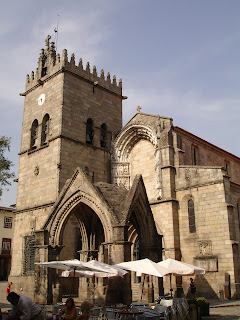
Padrão de D. João I
De acordo com alguns historiadores, este Padrão terá sido mandado construir por D. João I, no século XIV, para comemorar a vitória da Batalha de Aljubarrota.»
«Muralhas de Guimarães
Representam vestígios das muralhas que envolviam a urbe vimaranense nos reinados de D. Dinis e D. João I – séculos XIV e XV. Alguns historiadores remetem as origens destas muralhas para o século X.
Igreja Nossa Senhora da Oliveira

Foi mandada reedificar pelo rei D. João I no século XIV, em consequência de uma promessa feita à Virgem Maria pela sua vitória da Batalha de Aljubarrota. |
Padrão de D. João I
De acordo com alguns historiadores, este Padrão terá sido mandado construir por D. João I, no século XIV, para comemorar a vitória da Batalha de Aljubarrota.»
quarta-feira, 18 de janeiro de 2012
A aleivosa

«
D. Leonor (1350?-1386)"D. Leonor Teles de Meneses era sobrinha de D. João Afonso Telo, 4º conde de Barcelos, e irmã de D. João Afonso Teles de Meneses, 6º conde de Barcelos, de D. Gonçalo Teles de Meneses, conde de Neiva, e de D. Maria Teles de Meneses. Foi casada com D. João Lourença da Cunha, de quem teve um filho, Álvaro da Cunha. Conseguida a anulação do seu primeiro matrimónio, casou com D. Fernando, em Leça do Bailio, em 1372." Bibliografia nº3 pág.168»(encontrado em http://www.citi.pt/cultura/historia/historiadores/fernao_lopes/leonor.html, 18/1/2012 ) |
Enquadramento histórico da "Crónica de D. João I"
Pareceu-me interessante este texto que encontrei na Breve História de Portugal de A. H. de Oliveira Marques (pp. 116-117). O livro (de que transcrevi apenas um excerto) está disponível para requisição na Biblioteca.

«As primeiras querelas sociais haviam já começado quando D. Fernando casara com Leonor Teles (1372). Prosseguiram durante todo o reinado, acirradas pelo descontentamento que a política bélica provocava de norte a sul do País. (...) Na falta de herdeiro masculino, a sucessão de D. Fernando passou para a sua única filha legítima. D. Beatriz, que ele casara com D. João I, rei de Castela, depois da sua terceira derrota. As cláusulas do matrimónio confiavam a regência e o governo do reino à rainha-mãe Leonor Teles, até filho ou filha nascer a Beatriz. Quaisquer que fossem as circunstâncias, os dois reinos deveriam viver permanentemente separados.
Manobras políticas e ambições pessoais impediram qualquer solução pacífica. D. João I de Castela decidiu invadir Portugal e tomar conta do poder. A este passo violento moveu-o, porventura, a crescente oposição ao governo de Leonor Teles e do seu amante, o conde João Fernandes Andeiro, um nobre galego.
Andeiro e Leonor, provavelmente apoiados pela maioria da nobreza terratente, tinham contra si as fileiras médias e inferiores da burguesia, sob o comando do mestre de Avis, D. João, filho ilegítimo do rei D. Pedro. Ao que parece, o mestre de Avis convidara a princípio o monarca castelhano a entrar em Portugal, de preferência a aceitar uma situação perigosa para os seus partidários e para si próprio. Mais tarde, porém, a situação mudou. O ódio contra Castela e os castelhanos (estava ainda fresca na memória de todos a devastação passada que se lhes devia) obrigou o Mestre de Avis a encabeçar uma revolta contra os dois grupos: Leonor Teles-Andeiro e D. João I-Beatriz. Ele próprio ajudou a matar o Andeiro, obrigou a rainha D. Leonor Teles a fugir e unir forças com D. João I de Castela e proclamou-se a si próprio "regedor e defensor do reino".»
quinta-feira, 20 de outubro de 2011
"Post" onde a História, o Inglês e a Literatura Portuguesa "articulam"
No sítio http://www.camelotintl.com/world/europe.html (indicado pela professora de História), encontram a seguinte cronologia:
Europe
| AD 1 | |
| 14 | Death of Roman emperor Augustus |
| 43 | Roman emperor Claudius invades Britain |
| 60 - 61 | Rebellion of Boudicca, queen of the Iceni, against Romans in Britain |
| 64 | Great Fire of Rome |
| 68 - 69 | Civil war in Roman empire after Emperor Nero dies |
| c. 80 | Completion of colosseum amphitheatre in Rome |
| AD 100 | |
| 116 - 17 | Roman empire reaches its greatest extent, under Emperor Trajan (98 - 17) |
| 122 - 38 | Hadrian's Wall built to defend province of Britain |
| 166 - 67 | Roman empire devastated by plague |
| 180 | Death of Emperor Marcus Aurelius; end of Pax Romana |
| AD 200 | |
| 212 | Roman citizenship formally extended to all free-born people within the empire |
| 235 - 84 | Long period of civil war and chaos in Roman empire |
| 271 - 76 | Building of Aurelian walls around Rome |
| 284 - 305 | Diocletian is emperor of Rome; major reforms; forms "Tetrarchy" of four emperors to rule the empire together |
| AD 300 | |
| 313 | Christianity tolerated throughout Roman empire |
| 324 | Constantine becomes sole emperor (western emperor in 312) |
| 330 | New city of Constantinople (now Istanbul) inaugurated on site of ancient Greek city of Byzantium in European Turkey |
| 360s | First invasions of Europe by Huns from central Asia |
| 378 | Romans defeated at Adrianople by Visigoths: Emperor Valens killed |
| AD 400 | |
| RELIGIOUS WORLDS | |
| 410 | Aaric the Goth, king of the Germanic people, the Visigoths, sacks Rome |
| 432 | St. Patrick introduces Christianity to Ireland |
| 445 | Attila the Hun attacks western Europe |
| c. 450 | Saxons from Germany begin to invade Britain |
| 451 | Attila defeated at Ch_lons |
| 476 | Germanic invader Odoacer expels Romulus Augustus, last emperor of Rome, and takes control of the city |
| AD 500 | |
| 527 - 65 | Reign of Justinian, Byzantine emperor; he tries to reunite the eastern and western branches of the Christian church which are bitterly divided |
| 529 | St. Benedict founds monastery at Monte Cassino, south of Rome |
| 529 - 34 | Justinian introduces codes of law |
| 552 - 53 | Monks smuggle silkworms to Constantinople from China; start of important Byzantine silk industry |
| 563 - 97 | St Columba comes from Ireland to spread Christian religion in Scotland |
| 597 | Mission of St. Augustine to England to convert the Anglo-Saxons to Christianity |
| AD 600 | |
| c. 600 | Beginning of an important period of art and literature in Ireland |
| c. 602 | Slavic tribes begin settlement of the Balkans |
| 664 | Synod of Whitby in England; Roman Christianity chosen in preference to Celtic |
| c. 670 | Syrian chemist, Callinicus, invents Greek Fire, a highly inflammable liquid used by the Byzantine army in battle; first used in Battle of Cyzicus c. 673 |
| c. 675 | Bulgars, nomadic people from the Russian steppes, settle in lands south of the Danube |
| AD 700 | |
| 715 | Muslim forces conquer most of Spain; only the mountainous north, home of the Basque people, remains independent |
| 732 | Charles Martel , king of the Franks, defeats Muslims at Poitiers in France, stopping Muslim advance northwards |
| 768 | Charlemagne becomes king of the Franks |
| 784 - 96 | Offa , king of Mercia in central England, builds defensive dyke between England and Wales |
| 787 | Vikings make their first raids on the coasts of Britain |
| AD 800 | |
| NEW NATIONS | |
| 800 | Pope crowns Charlemagne emperor of Rome on Christmas Day in St Peter's Church, Rome |
| c. 800 | First castles built in western Europe |
| 809 - 17 | War between the Byzantine empire and the Bulgars - Khan Krum of Bulgaria defeats Byzantines in 811 and kills their emperor |
| 814 | Death of Charlemagne |
| 841 | Vikings found Dublin on east coast of Ireland |
| c. 843 | Charlemagne 's Frankish empire breaks up |
| 843 | Kenneth /MacAlpin unites kingdom of Scotia and becomes first king of Scotland (dies c. 859) |
| 844 - 78 | Rule of /Rhodri Mawr , first prince of all Wales |
| c. 860 | Vikings rule at Novgorod in Russia |
| 862 | Vikings led by /Rurik are invited by East Slavic and Finnish tribes of north Russia to rule them |
| 871 - 99 | Reign of Alfred The Great of England |
| 878 | Alfred defeats Vikings under Gudrum at Ethandune; Treaty of Wedmore divides England between them |
| 885 - 86 | Vikings raid Paris in France |
| c. 891 | Monks write the history of England in Anglo-Saxon Chronicle |
| AD 900 | |
| c. 900 | Magyars, nomadic people from central Asia, invade Europe |
| 910 | Benedictine Abbey of Cluny is founded in Burgundy, France |
| 911 | Rollo, Viking chief, settles in Normandy, France |
| 912 - 61 | Rule of Abd-al-Rahman III, Omayyad caliph of Cordoba, Spain; during his peaceful reign he develops arts and industry, such as paper-making |
| 936 - 73 | Reign of Otto The Great, king of Germany; he is crowned Holy Roman emperor in 962 |
| 937 | Athelstan of England defeats large army of Scots, Irish, and Danes at Battle of Brunanburh, northern England |
| 942 - 50 | Record of Welsh law is written down on the orders of Hywel Dda, Prince of all Wales |
| 955 | Otto defeats Magyars at Battle of Lechfeld, near Augsburg, and defeats Slavs at Reichnitz |
| 963 | Mieszko I founds kingdom of Poland; he is succeeded by Boleslav I, who expands its territory greatly |
| 976 - 1025 | Reign of Basil II, Byzantine emperor who defeats Bulgarians in 1014 |
| 978 | Vladimir becomes Grand Prince of Kiev |
| c. 986 | Eric The Red, Viking explorer, sets up a colony in Greenland |
| 987 - 96 | Reign of Hugh Capet, first Capetian king of France |
| c. 989 | Vladimir of Kiev chooses Orthodox Christianity as the official religion for his people |
| AD 1000 | |
| MONKS AND INVADERS | |
| 1020 | Italian towns, including Rome, Florence and Venice, become city states |
| 1000 - 38 | Rule of Stephen, first of Arpad dynasty of Hungary; he accepts Christianity for his people |
| 1014 | Brian Boru, High King of all Ireland, defeats Vikings at Battle of Clontarf, but is killed after victory |
| 1016 - 35 | Reign of Canute, Viking king of England, Denmark, Norway and Sweden |
| 1019 - 54 | Yaroslav the Wise, ruler of Kiev in Russia, unifies many Russian principalities |
| 1020s | Boleslav I of Poland creates a powerful state |
| 1034 | Scotland becomes united down to present border with England |
| 1035 - 66 | Normandy in north of France grows powerful |
| 1037 | Spanish kingdoms of Castile and Le¾n unite |
| 1054 | Split between Catholic church of Rome and Orthodox Christian church of Byzantium |
| 1066 | William Duke of Normandy, defeats Harold of England at Battle of Hastings |
| 1072 - 91 | Norman armies conquer Sicily |
| 1077 | Pope Gregory expels Holy Roman Emperor Henry IV from church; Henry pleads forgiveness, but conflict between empire and Papacy continues into 12th century |
| 1086 | Survey of England by order of William I is recorded in Domesday Book |
| 1098 | Monastery founded at Citeaux in France; start of Cistercian order of monks |
| AD 1100 | |
| c. 1115 - 42 | French teacher Henry IV makes Paris centre of religious learning |
| 1115 - 53 | Career of Bernard of Clairvaux, whose abbey becomes most important monastery in Europe |
| 1119 | Bologna University founded in Italy; Paris University, in France, is founded in 1150 |
| 1124 - 53 | David I rules Scotland |
| 1132 - 44 | St Denis Abbey, the first Gothic church, built by Abbot Suger in Paris |
| 1139 - 85 | Alphonso I becomes first king of Portugal |
| 1152 - 90 | Reign of powerful Holy Roman emperor Frederick I, called Barbarossa (red beard) |
| 1154 - 89 | Reign of Henry II Plantagenet of Anjou as king of England; he reforms law and government |
| 1171 - 72 | Henry II invades Ireland and is accepted as its lord |
| 1180 - 1223 | Philip II Augustus rules France, conquering Angevin lands in the west |
| 1190 | Teutonic Order of knights, a military society, set up in Germany to defend Christian lands in Palestine and Syria |
| AD 1200 | |
| CONQUEST AND PLAGUE | |
| 1209 | St Francis of Assisi founds Franciscan religious order |
| 1212 | Almohads defeated by Christians at battle of Las Navas de Tolosa |
| 1215 | English King John seals Magna Carta, giving more power to barons |
| 1240 | Russian Alexander Nevsky defeats Swedes at great battle on the Neva river |
| 1241 | L_beck and Hamburg form a Hansa (association) for trade and mutual protection; beginning of Hanseatic League |
| 1249 | University College, first college of Oxford University, England, founded |
| c. 1254 | Explorer Marco Polo born in Venice |
| 1262 | Iceland and Greenland come under Norwegian rule |
| 1273 | Rudolph I becomes first Habsburg ruler of Austria |
| 1282 - 84 | Edward I of England conquers Wales |
| 1284 | Peterhouse, first college of Cambridge University, founded in England |
| 1284 | Sequins coined in Venice, Italy |
| c. 1290 | Invention of spectacles in Italy |
| 1291 | Three Swiss cantons join together to begin struggle for independence from Habsburgs |
| AD 1300 | |
| 1308 | Papal court moves to Avignon; Great Schism follows |
| 1314 | Scots defeat English at Battle of Bannockburn |
| 1337 | Edward III of England claims French throne - 100 Years War (1337 - 1453) begins |
| 1346 | English defeat French at Battle of Cr_cy |
| 1347 | Bubonic plague or Black Death reaches Europe |
| 1358 | Jacquerie Revolt; peasant uprising north of Paris, France |
| 1370 | Geoffrey Chaucer writes first book, Book of the Duchess |
| 1373 | Treaty of Anglo-Portuguese friendship; the English and Portuguese are still allies today |
| 1381 | Peasants' Revolt in England led by Wat Tyler |
| 1389 | Christian Serbs defeated by Ottoman Turks at Kossovo in Serbia |
| 1397 | Kalmar Agreement unites three Scandinavian kingdoms of Denmark, Norway, and Sweden |
Subscrever:
Mensagens (Atom)